Top Signs You Need Garage Door Service – Don’t Ignore These
Most failing garage doors announce themselves for months before they quit. The trouble is that the warnings sound like normal quirks: a little slower, a little louder, a slight shimmy on the way up. A door that takes three seconds longer to open than it did six months ago isn’t “just slow” – that’s spring tension loss, and it usually puts you within 90 days of a full spring failure. The signals below are mechanical and predictable. Read them as diagnostic information, not background noise. If any of this sounds like your door and you’d rather not climb a ladder to check, call (855) 604-5978.
Key Takeaways
- A door that has slowed down is losing spring tension, not getting “lazy.”
- Uneven movement points to a cable or drum problem on one side – and a different fix than a spring imbalance.
- A door that reverses before reaching the floor is almost always a sensor alignment issue, not a dead motor.
- Monthly visual checks catch cable fraying and drum rust long before they cause a dangerous snap.
- Noises have signatures. Springs, rollers, and cables each fail with a distinct sound.
How much does a slow, heavy garage door tell you about spring health?
A slow and heavy door is the clearest early warning you’ll get, and it’s almost always about spring tension. Torsion and extension springs do the lifting; the opener only guides the door. As spring tension fades, the motor works harder to compensate, so the door drags and the opener labors. You’ll notice it first on cold mornings, then more often. Left alone, a weakening spring doesn’t slowly improve – it reaches a breaking point and snaps, usually when the door is under load. That’s why spring repair is a named specialty for us rather than an afterthought. Springs are the highest-tension component in your garage system, and here’s how we handle them safely: with the right winding bars, the door secured, and the opener fully disconnected before anyone touches the assembly.
You can confirm spring health without touching anything load-bearing. Here’s the balance test, and it’s the single most useful check a homeowner can do:
- Close the door and disconnect the opener using the manual release cord.
- Lift the door by hand to about waist height.
- Let go. A healthy door holds roughly where you left it, or drifts only slightly.
- If it drops fast or won’t stay up, the springs aren’t carrying their share.
That test takes a minute and tells you more than a visual inspection ever will. If your door fails it in Capitol Hill, that’s your cue to book service before the spring decides for you.
Why does my door move unevenly, and what does each cause mean?
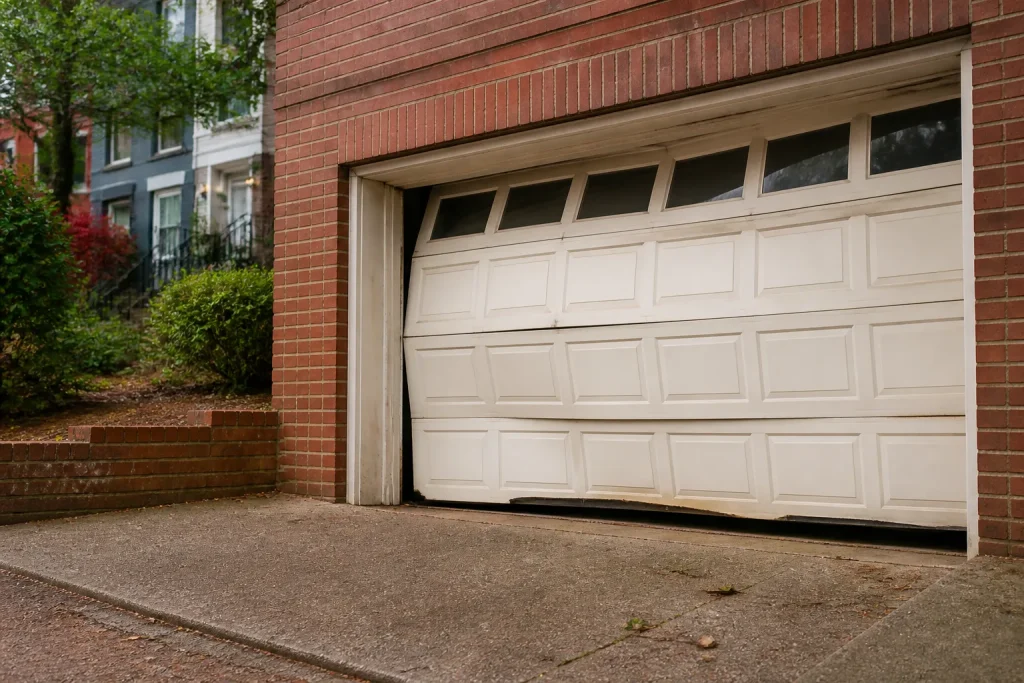
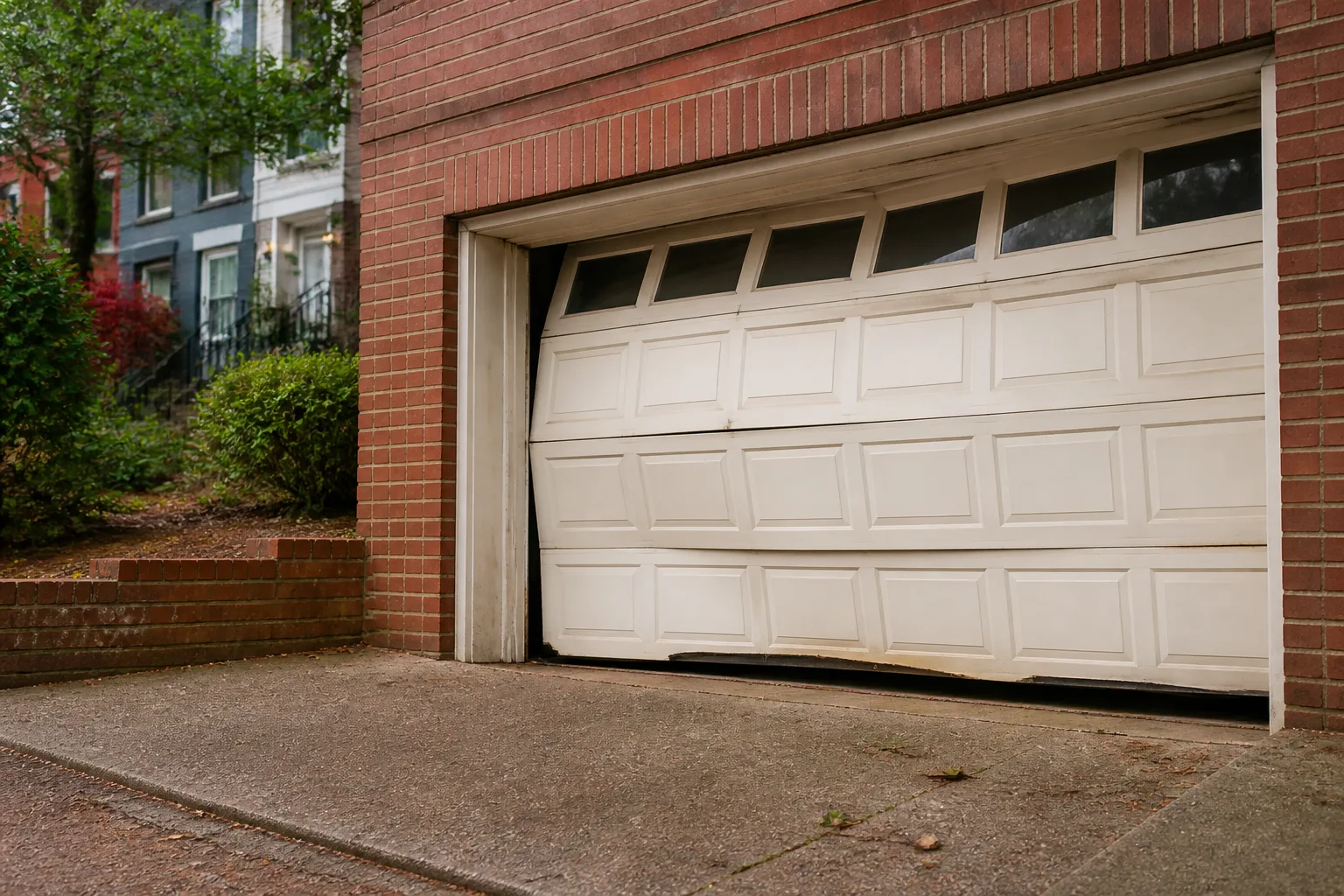
Uneven movement – one side climbing faster than the other – is worth taking seriously because the fix depends on which component is failing. Two different problems produce this symptom, and they need different repairs. Misreading it wastes money on the wrong part.
- Cable drum wear. Each side of the door rides on a cable wound around a drum. If one drum is worn, misaligned, or the cable is slipping on it, that side lags. The door tilts visibly as it rises. This is a cable-and-drum fix, not a spring fix.
- Spring balance. A single torsion spring or a pair of extension springs can lose tension unevenly, so one side carries less load. The door may rise crooked but smoothly, rather than jerking.
- Track or roller binding. A bent track or a seized roller on one side adds resistance and drags that corner.
We diagnose by brand and by symptom rather than guessing. A Clopay sectional door with a slightly bowed panel and an Amarr steel door with a worn drum can produce the same crooked rise for entirely different reasons. If the tilt is pronounced, stop running the opener. A door running out of square stresses the cables and can pull them off the drum, which is a genuine safety issue and worth a same-day call. Our technicians have up to 8 years of experience reading exactly this kind of pattern.
What do the noises actually mean? Spring versus roller versus cable
Garage door sounds have signatures. Learning to tell them apart tells you which part is failing and how urgent it is. In our experience, homeowners describe the noise vaguely (“it’s been loud lately”), but the specific character of the sound is the diagnostic clue.
- A failing torsion spring: a sharp, metallic twang or a heavy bang from the header area above the door. If you hear a single loud crack and the door suddenly won’t lift, the spring has likely broken. Stop using the opener immediately.
- A worn roller: a rhythmic squeak or grinding that keeps time with the door’s travel – louder as that roller passes the same spot on the track. It’s usually annoying before it’s dangerous, but a seized roller scores the track.
- A dry or fraying cable: a scraping or rasping sound as the cable winds onto the drum, often paired with a visible fray. A dry cable needs lubrication; a fraying one needs replacement.
One sound you can safely act on yourself is a squeaky roller. A little garage-door lubricant on the rollers and hinges quiets most of them. A twang from the spring area is different – that’s not a lubricant problem, and it’s not a job to take on yourself. The high tension stored in a wound spring can cause serious injury if released incorrectly, so a trained technician should handle it.
Why does my door reverse before it hits the floor?
A door that goes down, stops, and reverses before touching the floor is almost always a sensor alignment problem, not a failing motor. The safety sensors sit near the floor on each side of the opening and shoot an invisible beam across it. If the beam is broken or misaligned, the opener reads an obstruction and reverses to avoid crushing something. You can confirm it in about 60 seconds.
- Look at the two sensor units. Each should have a small indicator light that’s solid, not blinking.
- If one is blinking or dark, the beam isn’t reaching its partner.
- Wipe both lenses clean and check that nothing – a broom, a recycling bin, a kid’s toy – is blocking the path.
- Gently nudge each sensor until both lights are solid, then test the door.
If the lights are solid and the door still reverses, the issue may be the sensitivity setting or the opener’s logic board. That’s where brand knowledge earns its keep. Genie and LiftMaster units each handle travel and force limits differently, so the same symptom gets a different adjustment. If the reversal happens inconsistently – sometimes fine, sometimes not – don’t ignore it. A door that reverses randomly is a safety concern, and it’s worth having checked in Capitol Hill before it becomes a stuck-door morning.
How do I check cables and drums monthly without touching anything dangerous?
Monthly visual checks catch the slow killers – rust and cable fraying – before they fail. The key is to look, not touch. Cables and drums are load-bearing, and even a door at rest holds tension on those parts. Keep your hands off the cables, drums, and springs entirely, and use your eyes from a safe distance.
- Cables: with the door closed, look at each cable where it runs down the side. A clean cable is smooth. A fraying one has broken strands sticking out, like a worn rope. Any fray means it’s time to replace it – a snapped cable can whip and cause serious injury.
- Drums: check the drums at the top corners for rust or a cable wound unevenly, crossing over itself instead of laying in clean coils.
- Springs: look for a visible gap or break in the coil, or heavy rust. A broken torsion spring has an obvious gap where the coil separated.
- Hinges and rollers: check for loose screws and cracked roller wheels. These you can safely lubricate.
Rust matters here because a dry, corroded cable weakens from the inside out. If you spot fraying, rust, or a gap in a spring, don’t run the door more than necessary. That’s a call-a-pro moment. We handle cable and drum work as part of our garage door repair service, and we work on the brands your door is most likely to be – Clopay, Amarr, Wayne Dalton, and more.
When should you call a pro instead of watching it?
Some signs are worth watching. Others mean stop and call. The difference is whether the problem involves the highest-tension parts – springs, cables, and drums – or the lower-risk hardware like rollers, hinges, and tracks. If you’re unsure which category your issue falls into, treat it as a pro call.
Call us when any of these are true:
- The door won’t open, or a spring has visibly broken (that loud crack).
- A cable is frayed, snapped, or lying loose.
- The door is crooked or hangs unevenly, or one cable looks slack.
- The door reverses repeatedly or won’t stay down.
- The opener hums but nothing moves – often a stripped gear or logic board.
- The door is off its track or a panel is bent.
We cover opener problems too, across the brands that fail most: a Genie or Craftsman opener with a dead board is a garage door opener repair job, and modern smart-home units get diagnosed by their specific logic rather than a generic guess. When a door fails and it can’t wait for a scheduled visit, our emergency service exists for exactly those situations – a compromised door is a security and safety matter today, not tomorrow.
Related services in Capitol Hill
Alongside repair, we handle full-door replacement when an aging system reaches the end of its life. If your panel damage or repeated failures point toward a new door, our garage door installation covers measuring, brand options, and a written price before anything is ordered.
The Bottom Line
The signs of a failing garage door are quiet at first – a little slow, a little crooked, a new noise – and homeowners often file them under “normal.” They aren’t. Slowing means spring tension loss. Uneven movement means a cable, drum, or balance issue. Reversing means sensor alignment. Frayed cables and rusted drums mean schedule service now. The balance test and the monthly look-around are the two habits that catch most of this early. If you’d rather not guess, or you’ve spotted any of these signs on your door in Capitol Hill, Garage Door Repair Capitol Hill offers free estimates and works on your specific brand. Call (855) 604-5978 and we’ll take a look.
Frequently Asked Questions
The earliest signs are usually a door that’s noticeably slower or heavier than it used to be, a new squeak or grinding sound, and a slight slant as the door rises. Any single one is worth a look. Two or more together point to progressive wear that’s worth a professional check before it becomes a breakdown.
Do the manual balance test: disconnect the opener, lift the door to waist height, and let go. A healthy door stays roughly in place; a failing one drops or won’t stay up. You may also hear a sharp twang or see a visible gap in the spring. Don’t touch the spring itself – springs are under high tension and a trained technician should handle them.
It’s usually a safety sensor issue, which is a common and safe-to-troubleshoot problem – check the sensor lights and clear any obstruction first. If the lights are solid and it still reverses, stop relying on it as a normally working door and have the opener checked, since a door that reverses unpredictably is a safety concern.
We’re familiar with the systems homeowners own most: LiftMaster, Chamberlain, Genie, Clopay, Amarr, Wayne Dalton, Craftsman, and Raynor. Knowing the brand means we diagnose by its actual logic and parts rather than guessing. Call (855) 604-5978 for a free estimate in Capitol Hill, and tell us your brand so we show up ready.
Written by the team at Garage Door Repair Capitol Hill.
Need Garage Door Help?
Call Garage Door Repair Capitol Hill - the local pro we connect you with is licensed and insured, here with fast after-hours help in Capitol Hill.
(855) 604-5978